
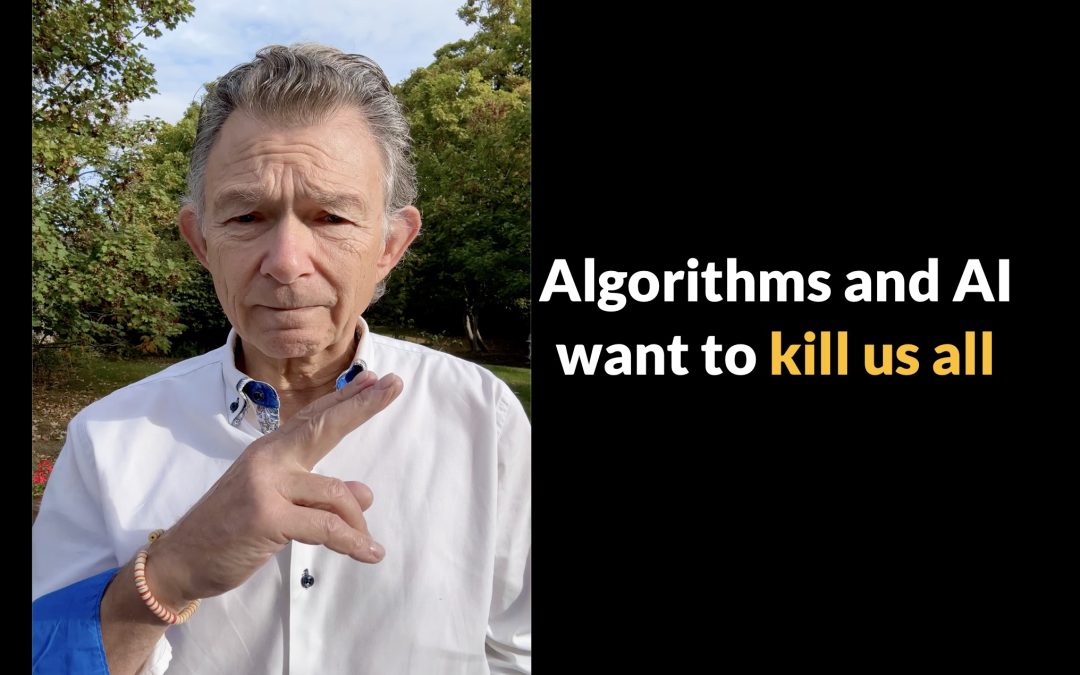
Algorithms and AI want to kill us all.
What’s wrong with that sentence?
Only one thing. Machines can’t want anything.
But they are built to chase goals. Relentlessly.
Give them a goal and they’ll find a way to achieve it. No guardrails. No boundaries. No conscience.
Tell one to double engagement and it learns fast. It will do whatever it takes to deliver. It turns out that people respond more to anger, violence and conflict than to happiness, harmony and beauty. So that’s what it serves up.
More outrage.
More division.
More of whatever holds your attention.
This isn’t theory. Researchers keep finding the same thing.
One study of X’s feed found that engagement-based ranking pushes provocative content, even when users say it’s not what they want.
Another study, in the journal Science, looked at more than one million links shared on Facebook and tens of thousands of tweets. It found that misinformation provokes more outrage and engagement than trustworthy news. And outrage is what gets people sharing, often without even reading it.
Now imagine an algorithm built to reward whatever gets shared.
In Myanmar, social media algorithms amplified fake news and posts designed to stoke violence.
The result: A genocidal campaign against the Rohingya.
And the platforms say:
“We’re just the postman.
We only deliver the letters.”
Really?
A postman doesn’t choose your post.
These platforms do.
Out of everything published, they pick the posts most likely to inflame and enrage. Then they push them through your feed. Again and again.
That’s not delivery. That’s editing. Editing for engagement.
Machines feeding us outrage because outrage is magnetic. Poisoning our minds. Unsettling our emotions. Normalising hate.
The world is becoming polarised.
Anything “other” is treated with suspicion.
If we don’t wake up, we may end up at war with each other.
Again.
I think about my father, Sir Nicholas Winton, who rescued 669 children from Nazi-occupied Czechoslovakia.
And I think about how he taught me to read the news.
He would ask me to take an article and underline the facts.
Then ask: do they seem reasonable?
Can I trust the source?
And what might be their agenda in publishing them now, or at all?
He told me: you’ll be surprised at how few facts there are in most news articles.
Now contrast that with social media feeds. Much of what fills them is clickbait – designed to capture your attention – with little thought for the consequences. And the algorithms will keep serving up more of the same. Because that’s what they’re trained to do.
You may think it’s news. Look again. Ask the questions my father taught me.
He believed we should be certain of our facts before making up our minds. And he showed that one person can change everything.
That is the Power of One.
Do what my father did.
Read between the lines. Underline the facts. Ask whether you can trust the source. Ask who benefits if you share it.
Just because a friend sent it doesn’t make it true.
Just because an influencer you like posted it doesn’t mean their sources are real.
The competition for your attention is relentless. Posts are designed to pull your strings.
Cut them.
You decide what you believe.
© Nick Winton 2024